
Diamond Education
The 4 Cs of Diamonds, Explained Plainly
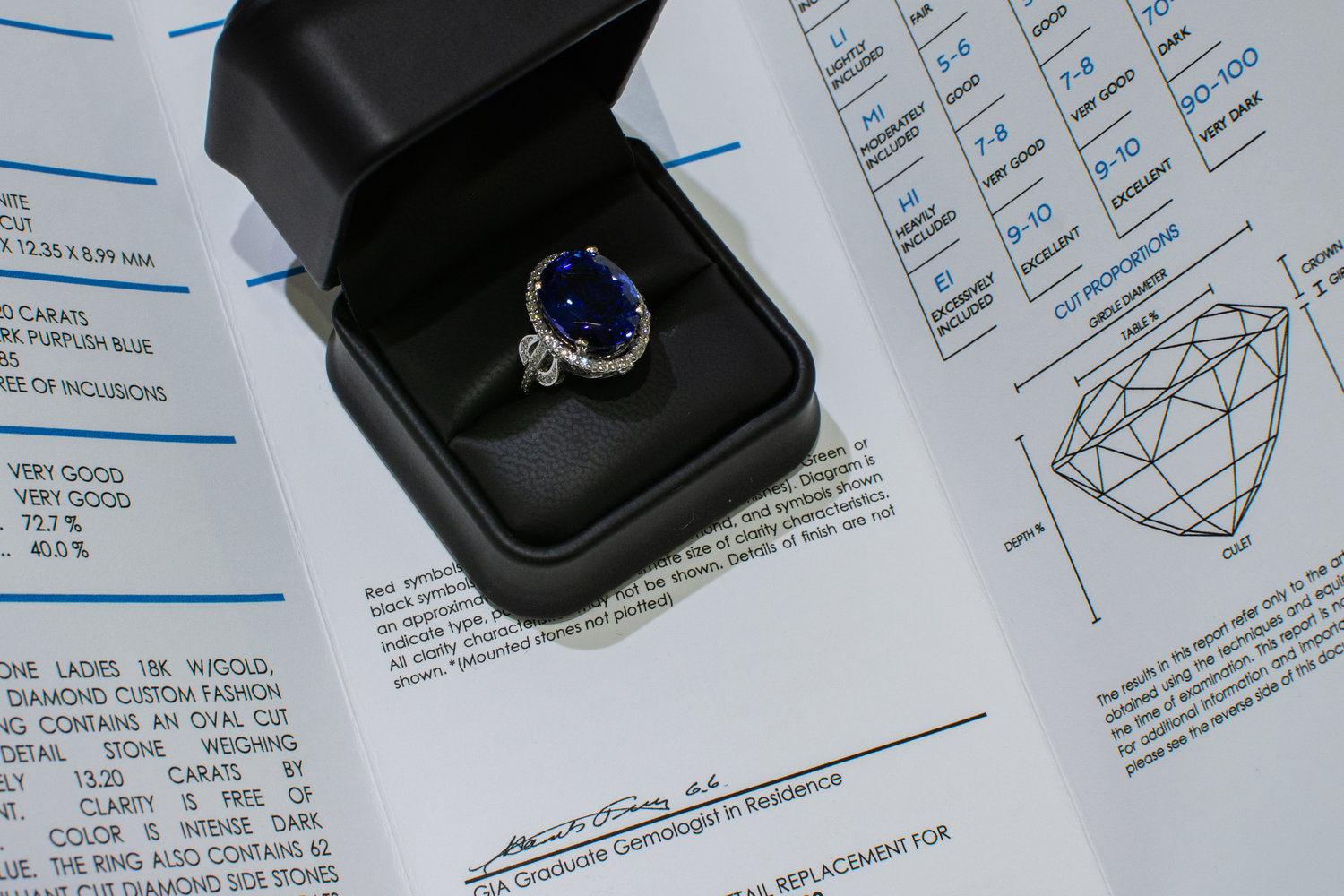
Most people hear about the 4 Cs on their first visit to a jewelry store. The acronym (cut, color, clarity, carat weight) was popularized by the Gemological Institute of America and it has been the standard diamond grading framework for decades. The grades are useful, but they can feel abstract until you have held two stones side by side. Here is each one in plain language, in roughly the order it affects how a diamond actually looks on someone’s hand.
Cut
Cut is the craftsmanship of the stone. It describes how well the diamond has been shaped, angled, and polished to interact with light. A well cut diamond returns light through the top of the stone as brightness, fire (flashes of color), and scintillation (sparkle as the stone or the viewer moves). A poorly cut stone leaks light out the back or the sides, and it reads dull.
Cut is graded Excellent, Very Good, Good, Fair, and Poor. On round brilliants, this grade is assigned by the GIA and appears on the report. On fancy shapes (oval, pear, cushion, emerald, etc.) the GIA grades polish and symmetry but does not assign an overall cut grade, because ideal proportions for fancy cuts are less standardized.
Here is the thing most customers are surprised to hear. Cut matters more than carat weight for how a diamond looks. A half carat round with an excellent cut will face up brighter and whiter than a three quarter carat round with a fair cut, often noticeably so. If you have a budget choice between “bigger with a worse cut” and “smaller with a better cut,” the better cut almost always reads as the more expensive stone to an untrained eye.
What to look for: Excellent or Very Good on rounds. For fancies, look at the stone in good light and under magnification. Bright, even light return across the entire face of the stone is the target. Dark areas or “bowties” in the center are cutting problems that will show up every time the stone catches daylight.
Color
Diamond color is graded D through Z, where D is colorless and Z shows a noticeable yellow or brown cast. The fancy color scale (vivid yellow, pink, blue, etc.) is separate and those stones are priced completely differently.
For a white diamond, the grades break down roughly like this:
- D, E, F. Colorless. The top of the scale, with matching price. The difference between D and F is invisible to nearly everyone outside a grading lab.
- G, H, I, J. Near-colorless. Face up white in most settings, especially with yellow gold or rose gold where the metal warms the stone anyway. This range is where most buyers land because the per-carat savings are significant.
- K through M. Faint tint. The stone will look slightly warm, which can be beautiful in yellow gold but shows as yellow in platinum or white gold.
- N and below. Noticeable color. Usually sold as antique or vintage cuts where the warmth suits the style.
There are two things to understand about color. First, color grades are set face down under controlled lighting with the stone loose. Once a stone is in a setting, small color differences collapse. A G in a halo setting looks nearly identical to a D. Second, metal choice matters. Warm metals hide color; cool metals amplify it. If you are buying a D or E stone and setting it in yellow gold, you are partly paying for color that the metal will visually neutralize.
What to look for: G or H is the sweet spot for most buyers. I is a reasonable stretch. J is possible with yellow or rose gold settings. If platinum is the plan, lean toward G or higher.
Clarity
Clarity measures the inclusions inside the stone and the blemishes on the surface. Every natural diamond has them. The scale runs Flawless (FL) down to Included (I3).
- FL and IF. Flawless or internally flawless. Extremely rare, priced accordingly, indistinguishable from VS to the eye.
- VVS1 and VVS2. Very, very slightly included. Inclusions visible under 10x magnification if you know where to look.
- VS1 and VS2. Very slightly included. Inclusions present but small. Eye clean nearly without exception.
- SI1 and SI2. Slightly included. Eye clean most of the time, especially SI1. SI2 can go either way depending on where the inclusions sit.
- I1, I2, I3. Included. Inclusions visible to the naked eye, often affecting the stone’s brilliance and sometimes its durability.
The important concept is “eye clean.” Eye clean means the inclusions are not visible to an average person at a typical viewing distance. SI1 stones are almost always eye clean. SI2 depends on where the inclusion sits (center table and you see it; under a prong and you never will). A well chosen SI1 or SI2 can look identical to a VS stone at a third less money.
What to look for: VS2 or SI1 is the value range. If you are buying SI2, look at the specific stone’s plotting diagram and ask the gemologist where the inclusions sit.
Carat weight
Carat is a measure of weight, not size. One carat equals 0.2 grams. Two stones of identical carat weight can look meaningfully different in size because the depth of the cut changes how much of the weight sits below the girdle (the widest part of the stone).
Carat weight pricing is not linear. Stones jump in price at round thresholds: 0.5 ct, 0.75 ct, 1.0 ct, 1.5 ct, 2.0 ct. A 0.98 carat and a 1.02 carat look the same to the eye but the 1.02 will cost noticeably more because it crossed the “one carat” threshold.
This is where smart shopping pays. A 0.90 carat well cut diamond with G color and VS2 clarity will face up as large as a one carat stone, look identical in a setting, and save you a meaningful percentage on the price.
What to look for: the millimeter measurement of the stone, not just the carat weight. For round brilliants, 6.4 to 6.5 millimeters is the typical one carat diameter. For fancies, it varies by shape.
What the grades do not tell you
Two other factors affect a diamond that the 4 Cs do not directly grade.
Fluorescence. Some diamonds fluoresce blue under UV light. Strong fluorescence can make a lower color stone (I, J, K) look whiter in daylight, which is a bonus. Very strong fluorescence in higher color stones sometimes causes a hazy appearance, which is a problem. GIA notes fluorescence on the report; ask about it.
Symmetry and polish. Both are graded by GIA, but separately from the cut grade. Excellent in both is ideal. Good is acceptable. Below that, the stone will show workmanship issues under magnification.
Applying the 4 Cs
If we had to reduce this to one paragraph: prioritize cut, treat color as a range (G through I for most buyers), pick VS or SI clarity depending on whether you want a safety margin, and let carat weight settle where your budget lands. If something has to give, let it be carat weight. A smaller stone that is well cut and eye clean will outperform a bigger stone with cutting or clarity compromises, every time.
If you want to see this in person, stop in. We keep a rotating inventory of GIA certified loose diamonds and our gemologist can walk you through two or three stones side by side in a few minutes. That beats any article.
Questions? Stop in or call.
Florida Diamond Center is at 2338 U.S. Highway 19 N, Holiday, FL 34691. We are open Monday through Friday 10 AM to 6 PM, Saturday 10 AM to 5 PM.